
 中文简体
中文简体 English
 Français
 Español
 عربى
عربى-

(86)-0571-82550327
-

info@bfseats.com
-




Counterbalance Forklift Seat Buying Guide: Suspension, EN 13490 Compliance and Fit
Content
- 1 What Is a Counterbalance Forklift Seat?
- 2 Why Seat Suspension Matters More on a Counterbalance Truck
- 3 Five Features That Separate a Durable Counterbalance Forklift Seat From a Cheap One
- 4 EN 13490 and ISO 7096: What the Certificates Actually Test
- 5 Replacing a Counterbalance Forklift Seat Without Surprises
- 6 Counterbalance Forklift Seat: Quick Answers
A counterbalance forklift has no springs between its axles and its frame. Every dock plate, yard pothole and floor joint travels straight through the chassis into the operator's back, and the counterbalance forklift seat is the only component engineered to absorb that input. This is why the seat, so often the last line on a purchase order, has an outsized effect on alertness, fatigue and long-term spinal health.
Hangzhou Benfeng Auto Seat Co., Ltd. has manufactured industrial vehicle seats since 2007, supplies seat programs to OEM brands including HANGCHA, LiuGong and EP, and took part in drafting JB/T 13693-2019, the Chinese machinery industry standard for industrial vehicle driver seats. The checklist below condenses that manufacturing and certification experience into decisions you can defend in a purchasing review.
of sprung travel separate the drive axle from the chassis on a typical counterbalance truck. The seat does all of the isolating, on every shift, over every bump.
What Is a Counterbalance Forklift Seat?
The short answer: it is an operator station built to do three jobs at once. It senses the driver, restrains the driver and isolates the driver. A car seat can skip the first two duties; a counterbalance seat cannot, because the truck's safety interlocks and its ride quality both depend on the seat doing them.
Counterbalance forklift seat: the operator compartment component mounted at the rear of a counterbalance truck, combining an operator presence switch that cuts travel and hydraulic functions when the seat is vacated, a belt anchorage, and a suspension mechanism that filters vertical shock before it reaches the spine.
Three hardware groups define the category:
- Operator presence switch (OPS) wired into the interlock circuit, so mast and travel functions stop the moment the driver leaves the cushion.
- A suspension layer, from a short-travel damped base on economy models to a weight-adjustable mechanical suspension on premium ones.
- A restraint system, typically a two-point or self-retracting belt anchored to the seat frame rather than the chassis.
Our BF23 shows how the three groups come together in one certified unit:
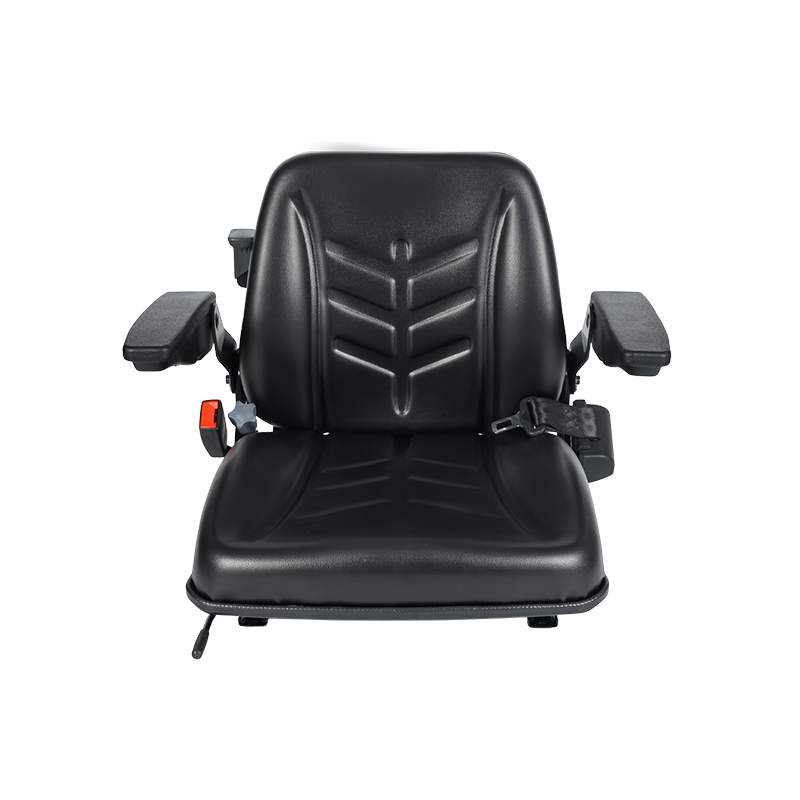
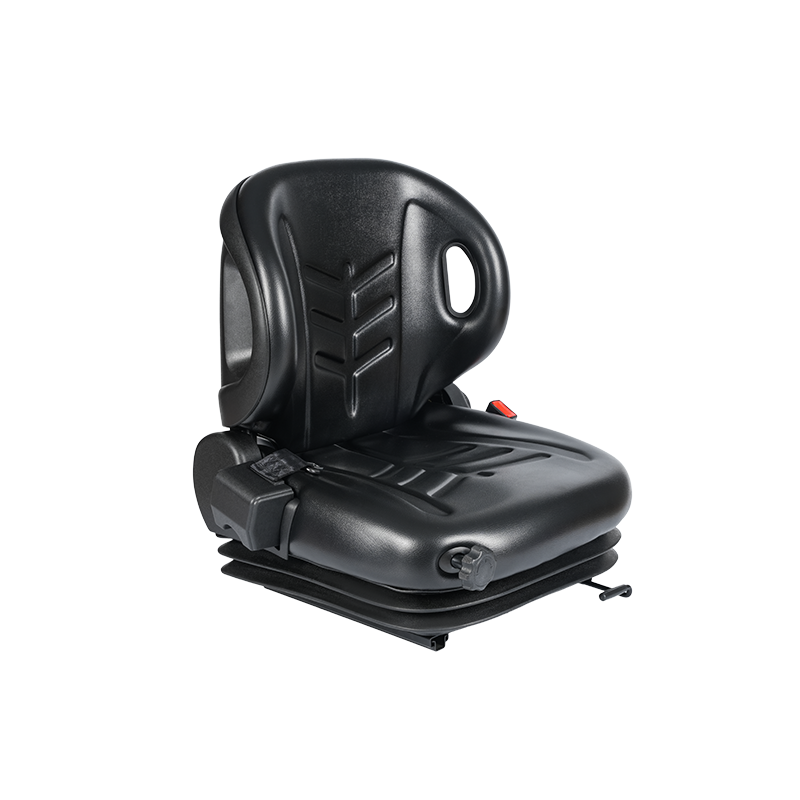 BF2-3AB Certified Counterbalance Forklift Seat with Mechanical Suspension and OPS SwitchA certified counterbalance seat with 40mm mechanical suspension, 60° backrest adjustment, 45-120 kg weight adjustment, universal mounting, retractable safety belt and OPS switch. It suits this discussion of vibration filtering, since the seat is usually the only suspension on a counterbalance truck.View Product →
Why Seat Suspension Matters More on a Counterbalance Truck
On most truck classes the seat is the main vibration filter; on a counterbalance it is usually the only one. Reach trucks and stackers work on smooth slabs at walking pace. A counterbalance works dock ramps, uneven yards and congested loading zones, and its rigid three-point wheel stance passes every input upward. Indoor cushion-tire units deliver sharp, high-frequency jolts from floor joints, while outdoor pneumatic-tire units add low-frequency bounce from yard surfaces.
That load profile is why stroke and damping belong at the top of the comparison sheet, ahead of upholstery color. Our detailed overview of choosing a mechanical suspension forklift seat covers weight-range adjustment and damper behavior in depth; the practical summary looks like this:
- Minimal or short damped travel, typically around 40 mm
- Suits short indoor cycles and smooth slab floors
- Lowest purchase cost and lowest fatigue protection
- 60 to 80 mm of stroke with damping tuned to operator weight
- Suits multi-shift duty, ramps and worn approach slabs
- Performance verifiable through EN 13490 class testing
Five Features That Separate a Durable Counterbalance Forklift Seat From a Cheap One
Two seats can share a spec photo and still behave nothing alike on the second shift of a summer afternoon. These five details do the separating:
- Weight-adjustable suspension: a dial covering roughly 50 to 120 kg tunes stroke and damping to the actual operator instead of a theoretical average.
- Low-profile backrest and frame: counterbalance cabs are tight, so the seat must clear the overhead guard and preserve rear sightlines toward the counterweight.
- Self-retracting seat belt: a belt that stows itself gets worn; a loose lap belt gets tucked under the cushion and forgotten.
- Heavy-duty PVC or single-mold polyurethane covering: HD PVC shrugs off hydraulic oil and sunlight in yard service, while one-piece polyurethane cushions wipe clean for food and pharmaceutical fleets.
- A sealed OPS switch: dust and moisture around the switch are a leading cause of nuisance interlock faults and unplanned downtime.
For internal combustion counterbalance fleets running multi-shift patterns, the BF11 packages these five points in an economical, certified format:
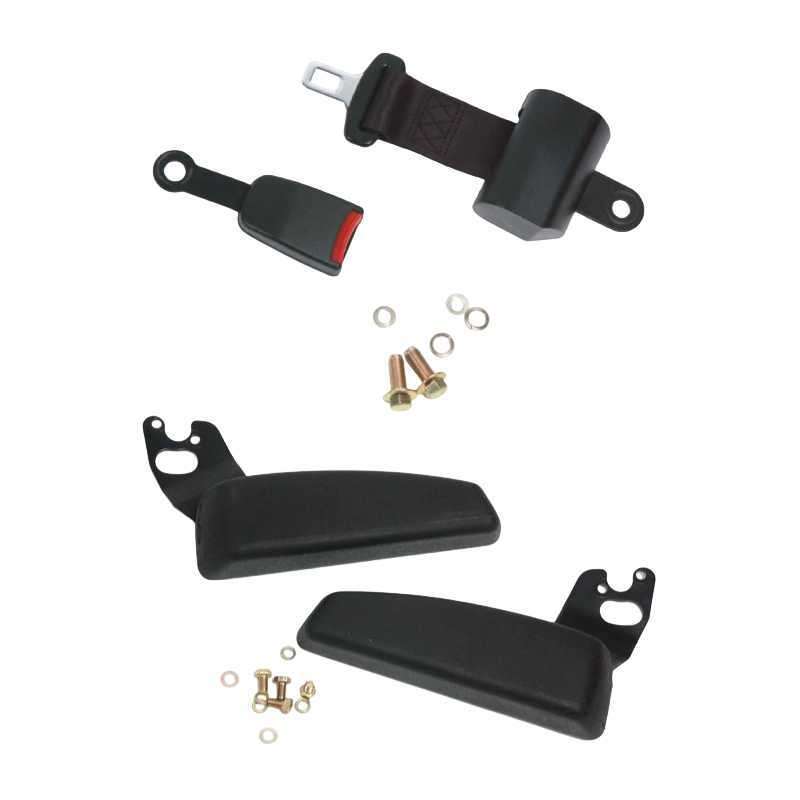 BF1-1 Ergonomic Forklift Seat for Internal Combustion Counterbalance TrucksThis economical vinyl seat is designed for diesel, gasoline, LPG and dual-fuel forklifts, with an 8° adjustable backrest, 75 mm fore/aft rails and the common 330x285 mm mounting pattern. It fits the article's point about certified, multi-shift seating for internal combustion counterbalance fleets.View Product →
EN 13490 and ISO 7096: What the Certificates Actually Test
Three test documents actually predict how a seat will hold up in service: EN 13490, ISO 7096 and the Chinese industry standard JB/T 13693-2019. Here is what each one measures and why it belongs in a purchasing file.
| Standard | What it measures | Why it matters in a purchase decision |
| EN 13490 (IT1, IT2) | Laboratory testing of industrial truck operator seats against defined input and impact classes | Confirms the suspension actually reduces transmitted shock for counterbalance duty, not just on paper |
| ISO 7096 (EM1, EM7) | Evaluation of seat vibration transmissibility using machine-class spectra | Provides a like-for-like number when comparing suspension seats from different suppliers |
| JB/T 13693-2019 | Chinese machinery industry standard for industrial vehicle driver seats | Defines baseline strength and safety requirements across the OEM supply chain |
When a supplier can name the test class and not just the standard, seat comparison turns from adjectives into data. Ask for the report, then match the class to the surfaces your trucks actually work.
Replacing a Counterbalance Forklift Seat Without Surprises
Most replacement projects go wrong on four measurable points, not on comfort. Record all four from the old seat before ordering anything:
Fleets that mix brands should work through the universal replacement seat compatibility guide before committing to a volume order. Where cab height is tight, a low-profile replacement such as the BF16 trades some stroke for guaranteed clearance:
Field note: suspension seats stiffen with age. If operators start standing partway through a shift, measure remaining stroke against the new-seat figure; a 30 percent loss is a reliable replacement trigger.
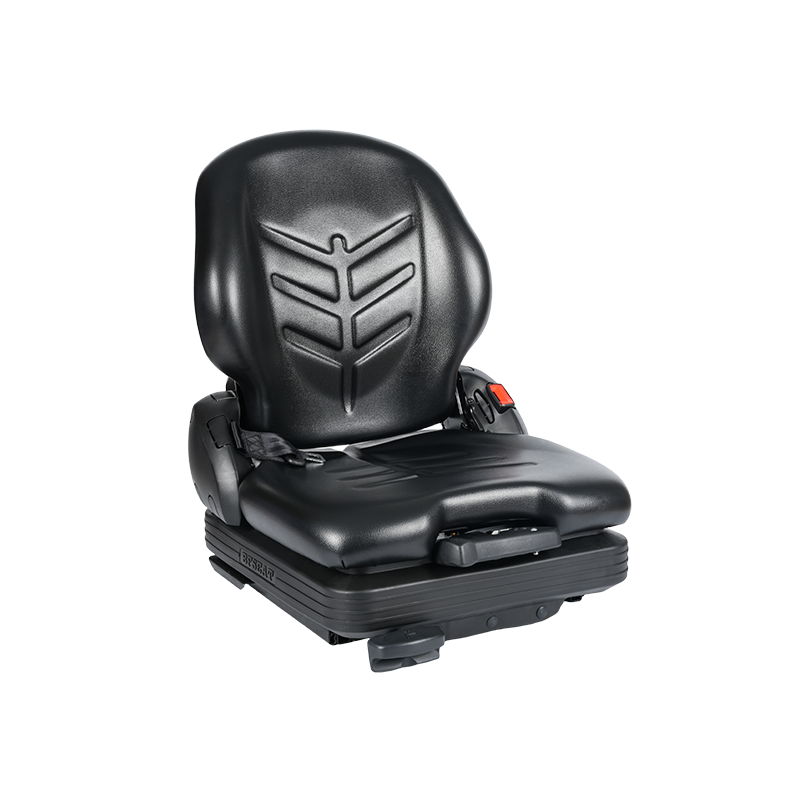 BF16 Low-Profile Mechanical Suspension Replacement Forklift SeatA low-profile replacement seat with 60/80 mm mechanical suspension travel, 80° backrest adjustment, 45-170 kg weight range, OPS switch and two-point ELR belt. It suits the field note on aging suspension seats, since measuring remaining stroke helps operators decide when replacement is due.View Product →
Counterbalance Forklift Seat: Quick Answers
Are counterbalance forklift seats universal?
No. Mounting patterns, rail lengths, OPS connectors and overhead-guard clearance differ across generations, so a seat can bolt on physically and still fail on wiring or fit. Run the four-point check above before ordering.
Is a seat belt required on a counterbalance forklift?
Sit-down counterbalance trucks are exactly the class where restraint matters most, because lateral tip-over is the dominant serious accident mode. Fit a compliant belt, anchor it to the seat frame, and treat a defective belt as an out-of-service condition.
How long does a counterbalance forklift seat last?
On multi-shift operations, plan for covering and suspension service between years three and five. Replace the seat when the stroke feels collapsed, the foam takes a permanent set, or the OPS switch starts failing intermittently.
What suspension stroke do I actually need?
Match stroke to surface and shift length: around 40 mm of semi-suspension covers short indoor cycles, while 60 to 80 mm of adjustable mechanical suspension suits multi-shift yards, ramps and worn slabs. Certification class is a better buying signal than raw stroke alone.
-
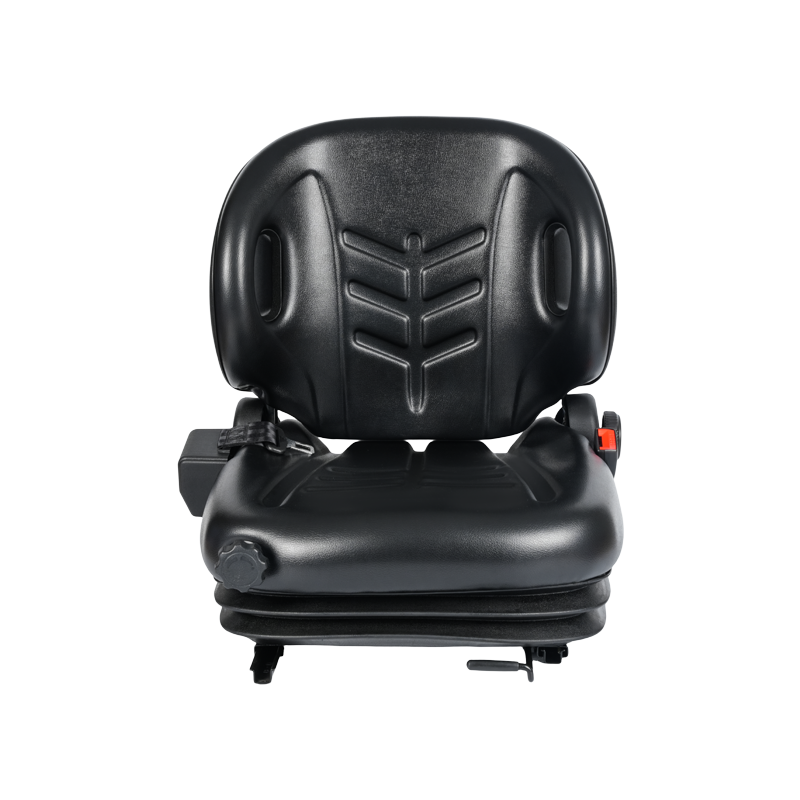
BF2-3AB EN13490 IT1+IT2 Certified Counterbalance Forklift Seat with Mechanical Suspension OPS Switch & Universal Multi-Function Mounting System Compatible with Toyota Jungheinrich
-
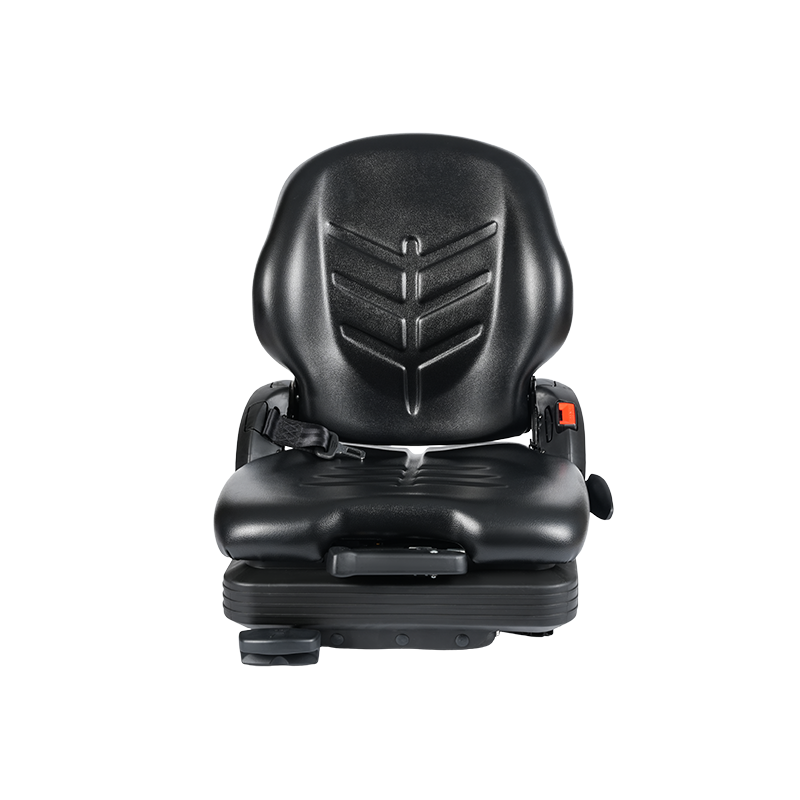
BF16 Low-Profile Vinyl Replacement Mechanical Suspension Seat for Material Handling Forklift Equipment - Black with EN13490 IT1+IT2
-
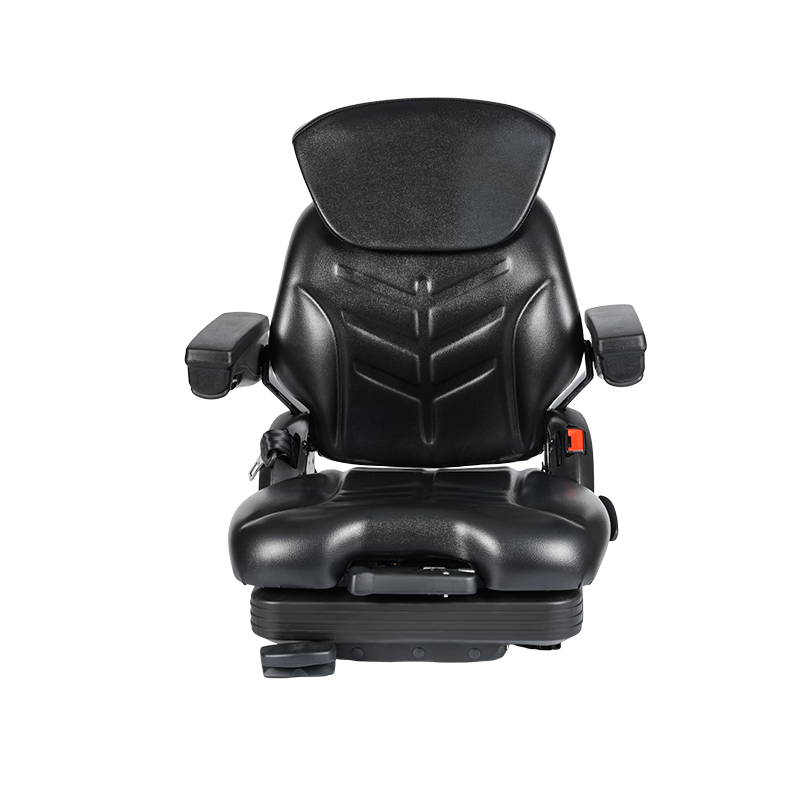
BF16MCD EN13490 IT1+IT2 & ISO7096 Dual-Certified Low-Profile Mechanical Suspension Seat Integrated seatbelt and OPS switch
-
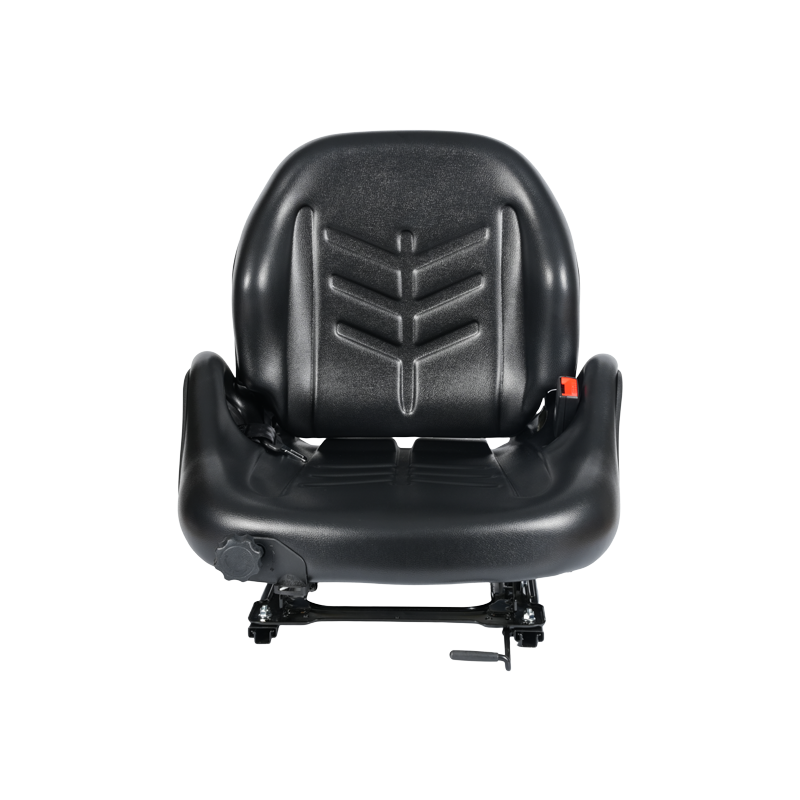
BF5-3 EN13490 IT1+IT2 Certified Suspension Seat with Safety Belt & OPS Switch | Wide-Operator Design Compatible with Hangcha, Nissan, TCM, Mitsubishi Forklifts
-
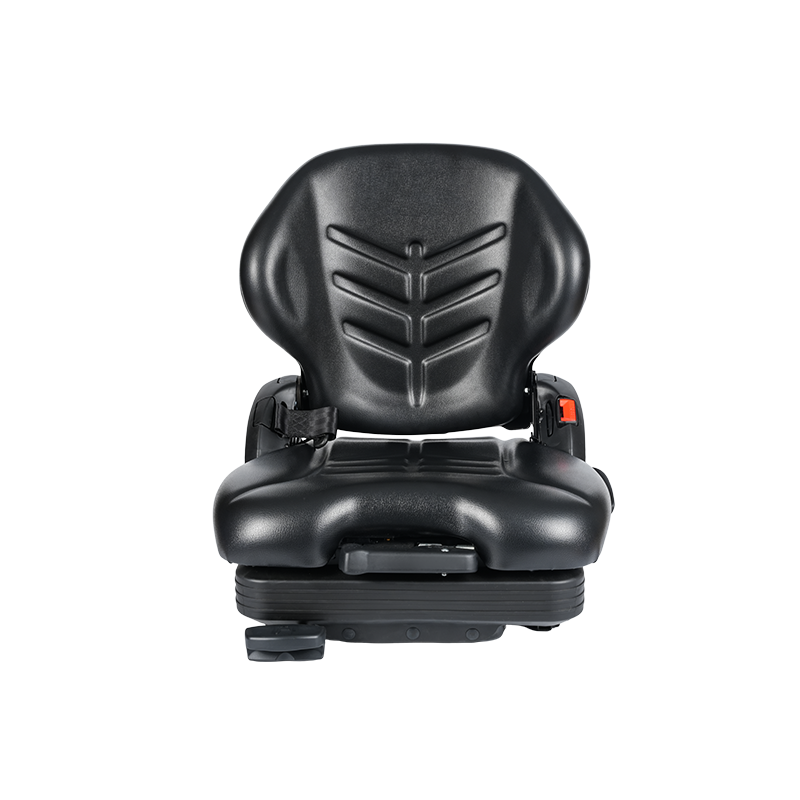
BF17 Ergonomically Advanced High-Comfort Forklift Seat with Back Support EN13490 Certified for Optimal Operator Well-being
Copyright @ Hangzhou Benfeng Auto Seat Co., Ltd. All rights reserved Privacy OEM/ODM Ergonomic Industrial Seats Manufacturers
浙ICP备20022099号