
 中文简体
中文简体 English
 Français
 Español
 عربى
عربى-

(86)-0571-82550327
-

info@bfseats.com
-




Which Cleaning Equipment Seat Fits Your Machine?
Content
- 1 Understanding Cleaning Equipment Seats
- 2 Industrial Cleaning Equipment Seat with Wheels
- 3 Ergonomic Cleaning Equipment Seat Adjustable Height
- 4 Replacement Seat for Floor Cleaning Machines
- 5 Heavy Duty Cleaning Equipment Seat Suspension
- 6 Universal Cleaning Machine Seat Accessories
- 7 How to Select Certified Cleaning Equipment Seats
- 8 Frequently Asked Questions
- 8.1 How do I measure for a replacement cleaning equipment seat?
- 8.2 What suspension type works best for ride-on floor scrubbers?
- 8.3 Are adjustable height seats worth the extra cost?
- 8.4 What certifications should I demand for cleaning equipment seats?
- 8.5 Can Hangzhou Benfeng develop custom seats for specialized cleaning machines?
- 9 Conclusion
- 10 References
Selecting the right seat for cleaning equipment impacts operator productivity and safety. Many buyers overlook seat specifications. They focus only on machine performance. This guide examines cleaning equipment seat requirements from an engineering perspective. It helps you make informed procurement decisions.
Hangzhou Benfeng Auto Seat Co., Ltd. started operations in 2007. The company participated in setting the "People's Republic of China Machinery Industry Standard JB/T13693-2019 - Industrial Vehicle Driver Seat". It holds the title of Zhejiang High-tech Enterprise. It holds the Specialized and New Enterprise designation. The company focuses on off-road construction machinery seats. It operates a 14,000 square meter production base. Annual output reaches 200,000 sets. The company provides safe and comfortable seat solutions. It serves material handling forklifts. It serves loaders. It serves tractors. It serves cleaning equipment. It maintains long-term relationships with industry leaders. These include Mitsubishi Logisnext, NICHIYU, HANGCHA, EP, Jungheinrich, Linde, KION, LiuGong, MIMA, and Goodsense. The company passed ISO 9001 certification. It passed ISO3834 certification. It passed ISO14001 certification. It passed ISO45001 certification. Products hold national invention patents. Products hold utility model patents. Products carry international CE certification. Some products passed European EN 13490 IT1 and IT2 certifications. Some products passed ISO 7096 EM1 and EM7 certifications.
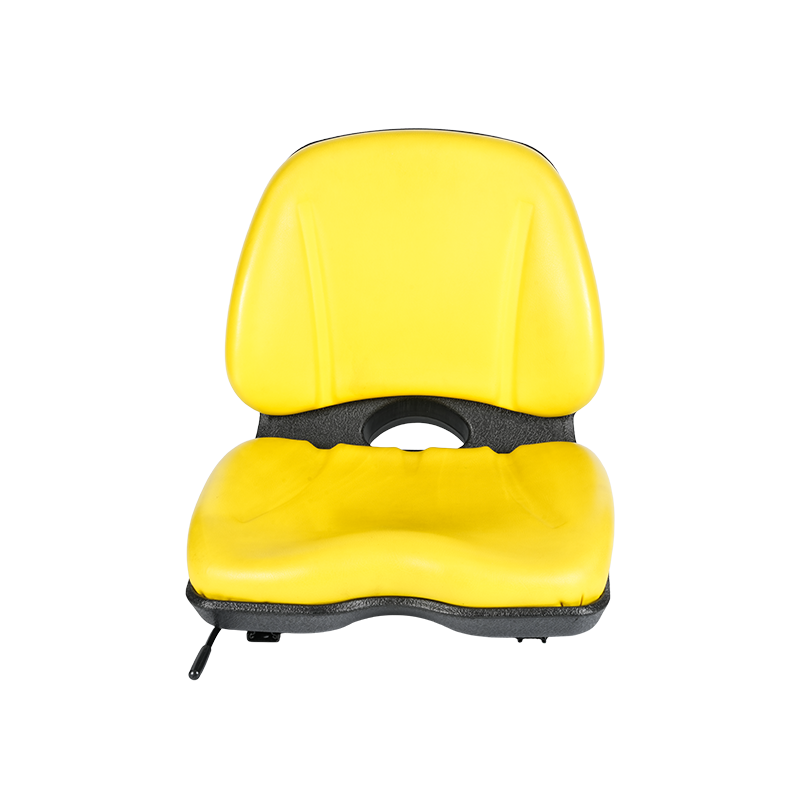
Understanding Cleaning Equipment Seats
What Makes Cleaning Machine Seats Different?
Cleaning equipment seats face unique challenges. Floor scrubbers and sweepers operate in wet environments. They encounter chemical cleaning agents. They work on uneven surfaces. Operators spend 4-8 hours seated. They need ergonomic support. They need durability.
Key differences from standard industrial seats include:
- Moisture-resistant materials prevent foam degradation
- Chemical-resistant covers withstand cleaning solution exposure
- Compact designs fit confined operator compartments
- Low seat heights accommodate frequent mounting and dismounting
- Vibration damping handles uneven floor surfaces
Key Ergonomic Requirements for Operator Comfort
Ergonomics directly affects operator performance. Poor seating causes fatigue. It reduces productivity. It increases injury risk.
Essential ergonomic features include:
- Lumbar support maintaining natural spine curvature
- Seat cushion density of 40-60 kg/m³ for pressure distribution
- Backrest angle adjustment from 5° to 15° forward of vertical
- Armrest height supporting relaxed shoulder posture
- Weight capacity rating matching operator population (typically 130-150 kg)
Industrial Cleaning Equipment Seat with Wheels
Mobility Benefits for Large-Area Cleaning
Industrial cleaning equipment seat with wheels enables operator movement during cleaning operations. Large floor scrubbers cover 10,000+ square meters. Operators need to reposition frequently. Wheeled seats reduce walking fatigue. They improve cleaning consistency.
Wheel configurations vary by application:
- Four-wheel stable base for straight-line travel
- Five-wheel base with central caster for 360° rotation
- Track systems for extreme unevenness
- Air-cushion systems for delicate floor surfaces
Wheel Configuration and Floor Compatibility
Wheel selection affects floor protection and mobility. Hard wheels damage coated floors. Soft wheels wear quickly on rough surfaces.
Wheel material comparison:
| Wheel Material | Floor Type Suitability | Load Capacity | Wear Resistance | Marking Risk |
| Polyurethane 95A | Smooth concrete, epoxy | 150 kg | Good | Low |
| Nylon | Rough concrete, outdoors | 200 kg | Excellent | Medium |
| Rubber | Tile, wood, delicate surfaces | 120 kg | Fair | Very Low |
| Pneumatic | Uneven, debris-covered surfaces | 180 kg | Good | Low |
| Cast Iron | Heavy industrial only | 500 kg | Superior | High |
Hangzhou Benfeng's Mobile Seat Solutions
Hangzhou Benfeng develops mobile seat platforms for cleaning equipment. Their designs incorporate five-wheel bases with central locking casters. This provides stability during machine operation. It allows quick repositioning during direction changes. Wheel materials are selected based on customer floor specifications. Polyurethane formulations resist cleaning chemicals. They prevent marking on polished concrete and epoxy floors.
Ergonomic Cleaning Equipment Seat Adjustable Height
Operator Anthropometry and Adjustability Ranges
Ergonomic cleaning equipment seat adjustable height accommodates diverse operator populations. Anthropometric data shows seated eye height ranges from 720mm to 980mm across adult populations. Cleaning equipment operators need visibility of floor surfaces and machine controls.
Recommended adjustment ranges:
- Vertical travel: 100mm minimum, 150mm preferred
- Lowest position: 400-450mm from floor (for easy mounting)
- Highest position: 550-600mm from floor (for visibility)
- Adjustment increments: 10mm for precise positioning
Proper seat height maintains 90-110° knee angle. This reduces joint stress. It improves circulation.
Vertical Adjustment Mechanisms Comparison
Height adjustment methods vary in precision, durability, and cost:
| Mechanism Type | Adjustment Range | Precision | Durability | Relative Cost |
| Manual Screw | 80-120mm | High (5mm steps) | Excellent | 1.0 baseline |
| Gas Spring | 100-150mm | Continuous | Good (5-year life) | 1.5x |
| Electric Motor | 120-200mm | High (1mm steps) | Good (motor dependent) | 3.0x |
| Mechanical Lever | 60-100mm | Moderate (10mm steps) | Very Good | 1.2x |
| Air Spring | 100-180mm | Continuous | Moderate (seals wear) | 2.0x |
EN 13490 Certification Standards for Adjustability
EN 13490 specifies requirements for industrial truck seats. It includes adjustability criteria. The standard defines IT1 and IT2 categories. IT1 covers basic industrial applications. IT2 covers severe applications with higher vibration and shock.
EN 13490 requires:
- Height adjustment capability for seats over 500mm reference height
- Backrest angle adjustment minimum 5° forward to 15° backward
- Seat adjustment forces under 100N for manual mechanisms
- Retention of position under 2g vertical acceleration
Hangzhou Benfeng products passed EN 13490 IT1 and IT2 certifications. Their adjustable mechanisms meet these force and retention requirements.
Replacement Seat for Floor Cleaning Machines
Compatibility Assessment for Retrofit Applications
Replacement seat for floor cleaning machines requires careful compatibility verification. Original equipment manufacturers use proprietary mounting patterns. Seat dimensions vary. Control integration differs.
Compatibility checklist includes:
- Mounting hole pattern (bolt circle diameter and thread specification)
- Seat width and depth versus compartment clearances
- Seat height versus control reach requirements
- Electrical connections for powered adjustments or sensors
- Weight capacity versus machine duty cycle
Mounting Pattern Standardization
Mounting patterns lack universal standardization. Common patterns include:
- Four-bolt rectangular: 200mm x 160mm or 240mm x 200mm
- Four-bolt square: 200mm x 200mm or 254mm x 254mm (10 inch)
- Slotted rail systems: 280mm to 400mm longitudinal adjustment
- Central pedestal mount: single large diameter threaded boss
Adapter plates bridge pattern mismatches. They add 15-25mm to installed height. They require verification of structural adequacy.
Hangzhou Benfeng's Universal Adapter Systems
Hangzhou Benfeng provides adapter solutions for replacement applications. Their engineering team analyzes existing seat mounting. They design adapter plates or modified base frames. This enables their certified seats to fit diverse cleaning equipment brands. Adapters maintain structural integrity. They preserve suspension travel. They accommodate original compartment clearances.
Heavy Duty Cleaning Equipment Seat Suspension
Vibration Isolation in Industrial Cleaning Applications
Heavy duty cleaning equipment seat suspension protects operators from whole-body vibration. Floor cleaning machines traverse expansion joints. They encounter surface irregularities. They generate vibration at 4-12 Hz frequencies. This matches human body resonance frequencies.
Health effects of prolonged vibration exposure include:
- Lower back pain from spinal compression
- Digestive disorders from organ vibration
- Hand-arm vibration syndrome from control operation
- Fatigue from constant muscular stabilization
Effective suspension reduces transmitted vibration by 60-80% at critical frequencies.
Mechanical vs. Air Suspension Performance
Suspension type selection depends on machine weight, surface condition, and cost constraints:
| Suspension Type | Isolation Efficiency | Adjustment Range | Maintenance Needs | Weight Capacity | Relative Cost |
| Mechanical Spring | 40-60% | Fixed or limited | Minimal | 100-150 kg | 1.0 baseline |
| Scissor Linkage | 50-70% | Height adjustable | Low (lubrication) | 120-160 kg | 1.3x |
| Air Suspension | 70-85% | Continuous height/weight | Moderate (air system) | 130-200 kg | 2.0-2.5x |
| Hydraulic Damping | 60-75% | Damping adjustable | Moderate (seals) | 140-180 kg | 1.8x |
| Active Electronic | 80-90% | Real-time adaptive | High (sensors/computer) | 150-200 kg | 4.0x+ |
ISO 7096 EM1 and EM7 Certification Requirements
ISO 7096 defines vibration testing for earth-moving machinery seats. It includes EM1 and EM7 severity categories. EM1 covers normal applications. EM7 covers severe applications with high shock and vibration.
Testing protocol includes:
- Input vibration spectrum simulating actual machine operation
- Seat transmissibility measurement at operator contact points
- Durability testing for 2 million cycles
- Environmental testing for temperature and humidity extremes
Hangzhou Benfeng products passed ISO 7096 EM1 and EM7 certifications. Their suspension systems meet severe application requirements for cleaning equipment operating on rough surfaces.
Universal Cleaning Machine Seat Accessories
Armrests, Headrests, and Control Integration
Universal cleaning machine seat accessories enhance operator comfort and control. Armrests reduce shoulder fatigue. They support control operation. Headrests benefit machines with reverse travel or slope operation.
Accessory specifications:
- Armrests: height adjustable 200-250mm above seat cushion, width 450-550mm
- Headrests: vertical adjustment 100mm, fore-aft adjustment 50mm
- Control mounts: integrated joystick or switch panel supports
- Seat belts: two-point lap belts or three-point harnesses for slope operation
Weather Protection for Outdoor Cleaning Equipment
Outdoor cleaning machines need weather-resistant seating. Rain, UV exposure, and temperature extremes degrade standard materials.
Weather protection features include:
- Marine-grade vinyl or thermoplastic urethane covers
- Closed-cell foam preventing water absorption
- Stainless steel or coated hardware resisting corrosion
- Drainage channels in seat cushion design
- UV stabilizers in plastic components
Aftermarket Customization Options
Hangzhou Benfeng provides customization services. They modify standard seats for specific applications. Options include special cover materials, heating elements for cold environments, and special color matching. Their product development department works with customers. They develop application-specific solutions. This leverages their ISO 9001 and ISO3834 certified processes.
How to Select Certified Cleaning Equipment Seats
Industry Standards and Compliance Verification
Certification ensures seat safety and performance. Key standards include:
- EN 13490 for industrial truck seats (IT1 and IT2 levels)
- ISO 7096 for earth-moving machinery seats (EM1 through EM9 levels)
- ISO5353 for seat dimensions and adjustability
- Directive 2006/42/EC for machinery safety (CE marking)
Verification steps include:
- Requesting test reports from manufacturers
- Checking certification body accreditation
- Verifying scope of certification covers intended application
- Confirming certification validity dates
Hangzhou Benfeng's Standard-Setting Expertise
Hangzhou Benfeng participated in establishing JB/T13693-2019. This is the "People's Republic of China Machinery Industry Standard - Industrial Vehicle Driver Seat". Their involvement demonstrates technical leadership. They understand regulatory requirements. They apply this expertise to product development. Their seats meet Chinese national standards. They meet international standards. This dual compliance supports global equipment manufacturing.
Frequently Asked Questions
How do I measure for a replacement cleaning equipment seat?
Measure the mounting bolt pattern (length and width between centers). Measure compartment width and depth for seat clearance. Measure from floor to mounting surface for height compatibility. Check for interference with controls or structures. Hangzhou Benfeng provides measurement guides. Their technical team reviews customer measurements. They recommend compatible models or adapter solutions.
What suspension type works best for ride-on floor scrubbers?
Mechanical scissor-linkage suspension suits most indoor applications. It provides adequate vibration reduction at moderate cost. Air suspension benefits outdoor machines or units operating on expansion joints and rough surfaces. It provides superior isolation but requires maintenance. Hangzhou Benfeng offers both types with EM1 and EM7 certifications.
Are adjustable height seats worth the extra cost?
Adjustable seats prove essential when multiple operators use the same machine. They accommodate height differences from 150cm to 190cm+. They improve visibility and control reach. For single-operator dedicated machines, fixed-height seats may suffice if positioned correctly. Hangzhou Benfeng provides cost-benefit analysis. They help customers select appropriate adjustability levels.
What certifications should I demand for cleaning equipment seats?
Minimum requirements include CE marking for European markets. EN 13490 IT1 covers standard cleaning equipment. IT2 covers severe duty applications. ISO 7096 EM1 covers normal vibration environments. EM7 covers high-vibration applications. Hangzhou Benfeng holds these certifications. They provide documentation with each seat shipment.
Can Hangzhou Benfeng develop custom seats for specialized cleaning machines?
Yes. Hangzhou Benfeng maintains a product development department. They create custom solutions for volume orders. They modify standard designs for special requirements. They develop completely new seats for unique applications. Their 14,000 square meter facility supports prototyping and production. Their annual capacity of 200,000 sets enables scale. Development cycles typically run 8-16 weeks depending on complexity.
Conclusion
Selecting the right cleaning equipment seat requires systematic evaluation. Industrial cleaning equipment seat with wheels improves mobility for large-area operations. Ergonomic cleaning equipment seat adjustable height accommodates diverse operators. Replacement seat for floor cleaning machines demands careful compatibility verification. Heavy duty cleaning equipment seat suspension protects operators from vibration injury. Universal cleaning machine seat accessories enhance comfort and functionality. Hangzhou Benfeng Auto Seat Co., Ltd. provides certified solutions across all these categories. Their standard-setting participation, comprehensive certifications, and manufacturing capacity support informed procurement decisions.
References
- European Committee for Standardization, EN 13490: Industrial Trucks - Seats - Technical Requirements and Test Methods, Brussels, 2013.
- International Organization for Standardization, ISO 7096: Earth-moving Machinery - Laboratory Evaluation of Operator Seat Vibration, Geneva, 2020.
- International Organization for Standardization, ISO 5353: Earth-moving Machinery, and Tractors and Machinery for Agriculture and Forestry - Seat Index Point, Geneva, 2021.
- European Parliament, Directive 2006/42/EC on Machinery, Official Journal of the European Union, 2006.
- Mechanical Industry Standard of the People's Republic of China, JB/T 13693-2019: Industrial Vehicle Driver Seat, Beijing, 2019.
- International Organization for Standardization, ISO 2631-1: Mechanical Vibration and Shock - Evaluation of Human Exposure to Whole-Body Vibration, Geneva, 1997.
- Human Factors and Ergonomics Society, ANSI/HFES 100-2007: Human Factors Engineering of Computer Workstations, Santa Monica, CA, 2007.
Copyright @ Hangzhou Benfeng Auto Seat Co., Ltd. All rights reserved Privacy OEM/ODM Ergonomic Industrial Seats Manufacturers
浙ICP备20022099号